
GHOST TALES
- Rachel Dalivane
- Nov 19, 2025
- 10 min read
Updated: Nov 24, 2025
It seems a rite of passage in today’s world to be ghosted. I’ve had my fair share of ghosts. They could cohabit a very large house together. I sometimes imagine them tucked into their rooms, folding the laundry, and sharing their pastimes in a Rachel-free zone. I admit it gives me a twisted feeling in the pit of my stomach. Have I been rejected? I can’t help but wonder when I check my messages. Times are not quite what they once were. I remember an era when someone would simply waltz up and ask if we could be friends. “Yes, of course,” I would say, glowing. That was a happy era of my life, pre-pubescent, and brightly lit with 90s attire. So I find myself thinking, what happened to us?
The rejections set in after college. Then it grew into an avalanche of washed-out nothingness. A dead space. Static. Some of them hurt bad. So bad that it seemed to leave a permanent mark on my soul. It was as if people were tearing themselves away, pieces of me scattering with them. An email chain would become a forgotten place with dusty questions left unanswered. I would find myself in a ghost town, the place “all vacancies.” From schoolmates to roommates, I found myself ghosted. It felt like rejection. It was as if I was playing musical chairs and there were no more chairs left for me to sit in. Eventually I quietly shuffled to my corner of the internet, no longer waiting on responses or even a measly “Facebook like.” Pictures of all the ghosts now drift through my mini feed like a cheap horror movie. Am I pathetic? It’s possible.
You’re probably wondering (and I know that I have), is this a “me thing?” Have I scared away all the friends? Am I an intolerable person? Do I laugh too loud? Am I belligerent? Do I stand too close? I often find myself standing at attention upon making contact with a new life form, waiting for cues to clue me into what seems to be the problem. In my many years of exile, I’ve had time to contemplate this. And if I had to guess, it might just be that I am simply too different to fit anywhere.
I invite the jeers and the sneers that you might be experiencing now. That’s right, get it out of your system. It’s okay, I get it. How might a thin, blonde, white, decent looking woman manage to feel out of place in American society? I have the classic Western traditional look after all. I even had a picket fence in the front yard of my house growing up. Yet, I’m not the hardcore white girl that fits into classic Americana. I don’t care for football (the American version, at least). I don’t even like barbecue. I am not particularly religious. I am not a housewife or a girl boss. I am not even Republican or Democrat. I simply toe the line between two parties, balancing carefully there. Shall I call it Middle Child Syndrome to be so wan on these details, drifting into ambiguity instead? I have avoided all groups of people, all the categories, and trends. I have avoided any means of popularity, seeking out singular people rather than a mob of mutualities. Sameness is something I simply struggle to indulge. Yet, it gets lonely without all the trends and cultural rituals. And I find that the most unpopular choice seems to be making no choice at all. I choose neither side. Therefore I am on the losing side. A vote of one. A soldier to my accidental individualism.
In high school, I recall the overdrawn tension between two sides of me. I was a varsity soccer player one day. And a band nerd the next. Both tribes hated the other. It was a rivalry for the ages in which athletes and musicians shamed each other for their assumed stupidity or awkwardness. It would appear that I was an oxymoron to coexist in both worlds, adamantly loving and excelling at both. Because in truth it seems that eventually we are all expected to pick a side.
Have you ever seen the Seinfeld episode about a charity drive? All the participants parade the streets of Manhattan clad with a uniform ribbon. Yet, unsurprisingly, Kramer refuses to wear a ribbon. His refusal to wear such a signifier of togetherness ultimately gets him attacked and thrown out. It feels an appropriate analogy, especially since the word “label” derives from the Old French word for “ribbon.” Eventually we all have to wear the ribbon and don the colors of our tribe. We are expected to choose a label. It makes sense too. Such a uniform can enhance the feeling of belonging. It’s just like wearing the colors of your team. There is strength in numbers and being left out will mean some impending doom to an individual, whether that be social ostracism or starvation. For humans, the label is everything.
It is a primitive necessity to belong in such a system of social cooperation. There are rituals and ceremonies, common jokes, and commonalities shared between these people. From the outside looking in, it might even look like a cult. And the first rule of the cult is to cut off communication with the outside world. A common enemy is bonding, and the enemy becomes everyone else. The lid can be set tightly on from there and all the people contained to mix and mingle like a heap of trail mix. And who can blame us? It’s in our DNA. Even monkeys do it. There was once a great war between feuding chimpanzee tribes. Their war story rivals the wars of our human experience, brutalizing opposition, claiming new territory, and fighting for alpha status. Hell, the chimps even do revenge like humans do. So the grudge holding and back turning, the judgments and labels, all seem to be a part of the human experience. At least in our society, the rejection is (usually) less violent. It is simply a cold shoulder and an empty inbox at the end of the day. So why does it hurt so much?
I wonder if the human experience has shifted and we have grown to want more than violence, tribalism, or the rejection that comes with these things. I once read that archeologists consider the first sign of civilization to be mended bones. Bones that once broke and then were healed suggest a proactive desire for resolution—even kindness. Though violence was the grassroots of humankind, it was not the beginning of civilized society. Violence was easier. Perhaps it was even empowering. Yet, the choice to heal sparked a whole new code for people to live by. Healing, it seems, was a counterrevolution to violence, undoing what wars and social prejudices had started. It was once a profound advancement to plant seeds and grow crops. To fall into orderliness rather than the chaos of war. To cohabitate. To nurture. To grow. These periods of peace throughout our history have been brief, however. And the primitive desire for disruption is a wicked seduction that we as a species cannot quite shake.
Even in a society of modernism, we find ourselves at the brink of war with one another, prepared to take offense and do battle with those we disagree. And though technology is the next great advancement in our society, I wonder if it has not shifted us back into a primitive way of thinking. I was once ghosted by a close friend because of her religious views. I lost a couple more because of my ambitions. Some ghosted me for an opinion or two. And others have simply not bothered to follow up for reasons unknown. There are judgments and labels that categorize us not simply as human or American, but in subcategories and factions like “trad wife” or “girl boss” or “gym bro.” It is not simply a matter of a generalized culture now, but a detailed array of off-shoots and trends. Social media becomes a billboard that might announce a particular label. We lift our banners in the form of gender identity or racial stereotypes. Our relationship status becomes a category to be checked in a box. Our political views become trumpeted. Duels are fought in the comment sections of posts. We have all declared our sides loudly. We have declared our biases and labels. So much that we can no longer live with the opposition. Disagreement becomes intolerable. And those that don’t fall in line get left behind. No longer are we a species of resolution. And no longer do we advance toward healing. We have undone ourselves into a rash of violent warfare enacted through social media. What strikes me the most, however, is the response of silence at the end of it. To ghost those we cannot agree with. To leave them behind and to proactively choose to disengage with their existence. Ironically a culture that insists upon acceptance has become a place of great rejection. Differing ideas are intolerable now. And diplomacy is a thing of the past.
If one has religious views, then he is a bigot. If a woman asks for female-only spaces, she too is a bigot. We proactively gauge whether a person is Republican or Democrat, jumping to conclusions at the slightest comment. If there is a pro-abortionist, she is a murderer. If someone speaks of feeding the poor through taxes, they are a Communist. All free market enterprises are assumed to be Capitalistic blackholes of greed and wealth. There is no room for grey. The line has been drawn in the sand. It is time to choose a side. The word “dogmatic” comes to mind. There is no tolerance for outsiders here.
I wonder sometimes if hatred is learned rather than inherent in all of us. Have we learned to grow cynical? And have we dished out that same cynicism to others in a way that we once disdained? “Cynical” means “dog” in Latin. It was used in relation to sneering dogs that seemed quite parallel to politicians in Ancient Greece. I think of that word often. Cynical. To become a sneering dog. And to become someone who no longer accepts a difference of opinion. To no longer reach for healing or resolution, even if it does simply mean to agree to disagree.
So I go back to my original question. What happened to all of us? The answer, of course, is that we have all grown up. There seems a strange fascination in our culture with adulthood. We are called to “be a man” or fit into traditional womanly roles, romanticizing motherhood and sexuality. We are pressured and forced into roles that we did not choose ourselves. It is merely expected of all of us. I see peers that once gave into whimsy who now give into systems and rules. And these rules become more important than the people within them. Love becomes the side note in a growing list of dogma. Religion becomes a place of judgment. Politics become a place of hatred rather than cooperation. It appears to me that any institution created for the betterment of humankind turns into a self-serving enterprise with humans serving it, rather than it serving them. Play becomes work. Callouses form. And we all learn that vulnerability is a weakness rather than strength. We no longer love and we no longer value friendship as children do. We are kings of convenience where friendship is a transactional way of life rather than a place of whimsy and wonder. We have become pirates fighting the battle against our own lost boy (and girl) former selves.
Neuroscientists find that play is an essential part of brain development. Play activates dopamine in the brain and establishes a secure attachment to the task in action. There is both a fear circuit and a hope circuit within us, and these circuits flip on and off according to our thoughts. When a fear response is activated, our sense of hope shuts down and our resilience to stress diminishes. In contrast, play and whimsy activate the hope circuit within us. Tasks like art and daydreaming don’t only entertain us, they nurture us and even heal us. Dopamine, after all, is a healing hormone. Yet, we often choose fear instead.
In Game of Thrones, Jon Snow is told to “kill the boy and let the man be born.” You probably know that Game of Thrones is an ultra-violent fantasy realm in which characters are routinely decapitated and brutally tortured. It is not too dissimilar to our own world, in fact. The choice of weapons is merely different. The fantasy feels like a chilling parallel to our own struggle for power and influence. This desire for power is fought over time and it is often done so in the most subtle of ways. The obvious, of course, is in the ways of war. There is the political sphere and the search for financial status. The everyday American citizen might even call herself exempt from these power dynamics. Yet, I wonder sometimes if the subtle things don’t hurt more. When a friend chooses to snub a close companion, or a person chooses to impress rather than encourage, these acts can feel like betrayals to someone lingering in the corner of a lonely existence. As adults, we make our schedules more important than the people around us. We create unspoken competition, implement rivalries, and establish hierarchy amongst ourselves. And that classic “drive-by hello” becomes a routine gesture of “I see you, but do not choose to hear you.”
Have we lost our ability to see people as human? Do we simply see others as the stereotypes we assign to them instead? Have we lost our humanity? I’m wondering these questions in the dark living room of my home, The Crown playing in the background. I see a people of decorum and rigidity, whose task for power is more important than the casual play and love of comrades. When children play, they simply drift between whimsies with gentle acceptance of others. They do not assign labels, nor do they judge. They will learn to judge later through their interaction with the world and the structures that enforce such categories upon them. Sometimes I wonder if we would all be better if life simply paused and we found our refuge in nature and the relationships that were once abandoned. It’s idealistic, I know. How are we supposed to survive without work and money, mortgages and so on? Yet, the real question is, why did we create such a world which dislodges us from our childlike whimsy? And how can we return home to ourselves and our connection to others without the obligatory sense of tribal exclusivity?
When the Celts celebrated Samhain, they didn’t simply throw on masks and feast. They lit bonfires so that they could drench a dark world with light. To them, the light was cleansing. It was a time to connect with their past and present, to merge the gap between worlds and acknowledge the people who had moved on before them. It was a time to honor others with intentionality, poetry, and beauty. There was meaning in their actions and there was humanity in their compassion. The ghosts were all awakened. And those broken bones were healed through fire. Is it too late to go back to such poetry? I wonder sometimes.
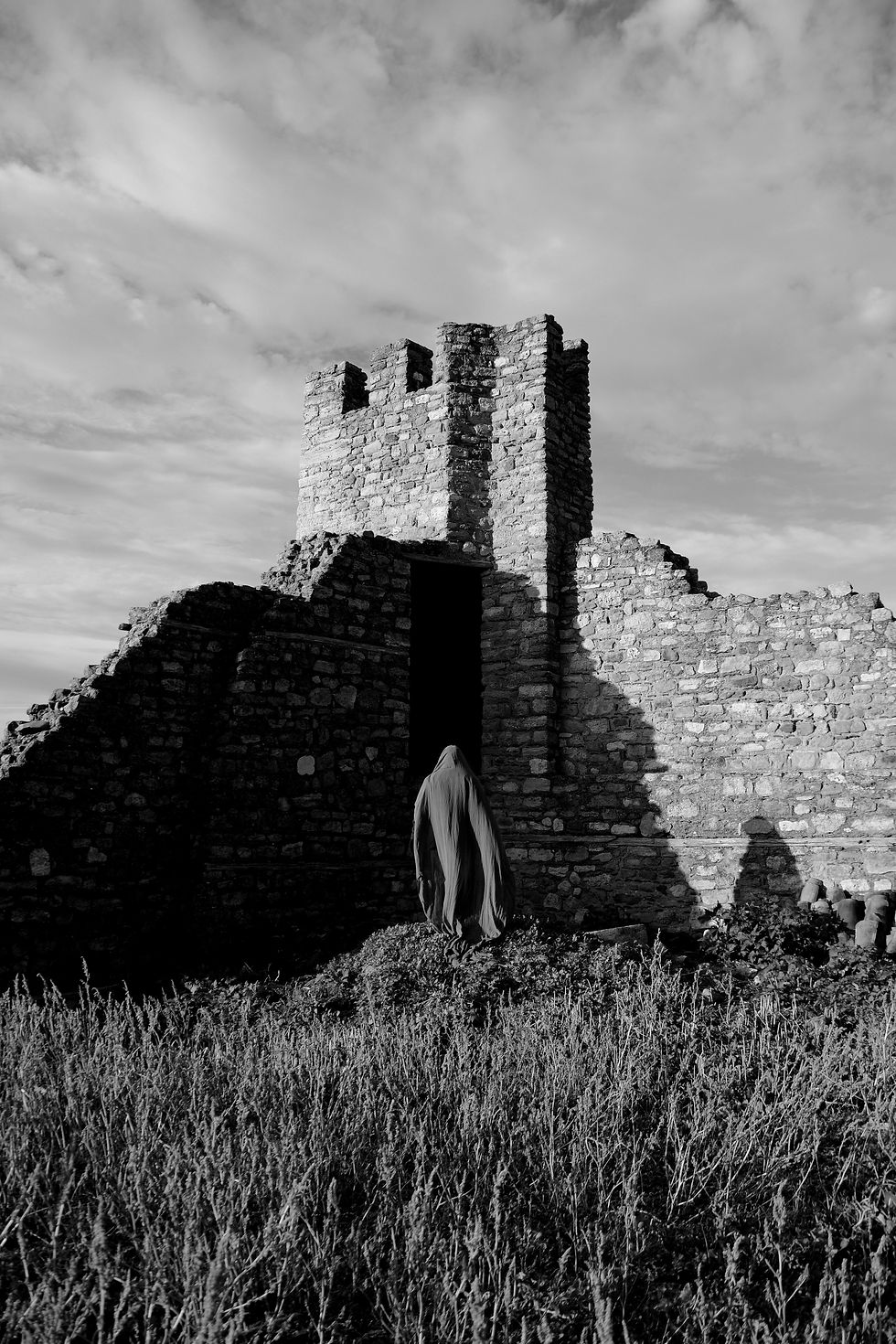
As for me, I care little for status or power of some kind. And I don’t bother to prove any sense of womanly stature. I do not care to prove a point. I have a Peter Pan Complex, you might say. I’d rather play than rule. And I’d rather capture a sense of whimsy than inspire the admiration (or fear) of others. I’m growing younger each year and reclaiming a piece of myself that I lost along the way. And I’m choosing acceptance over cynicism. Voltaire once wrote, "the most important decision you make is to be in a good mood.” I remember that on days when I feel a sneer forming on my face. And those ghosts—I’ve put them in a distant castle somewhere where they can live comfortably for the rest of time.


Comments